 Voortware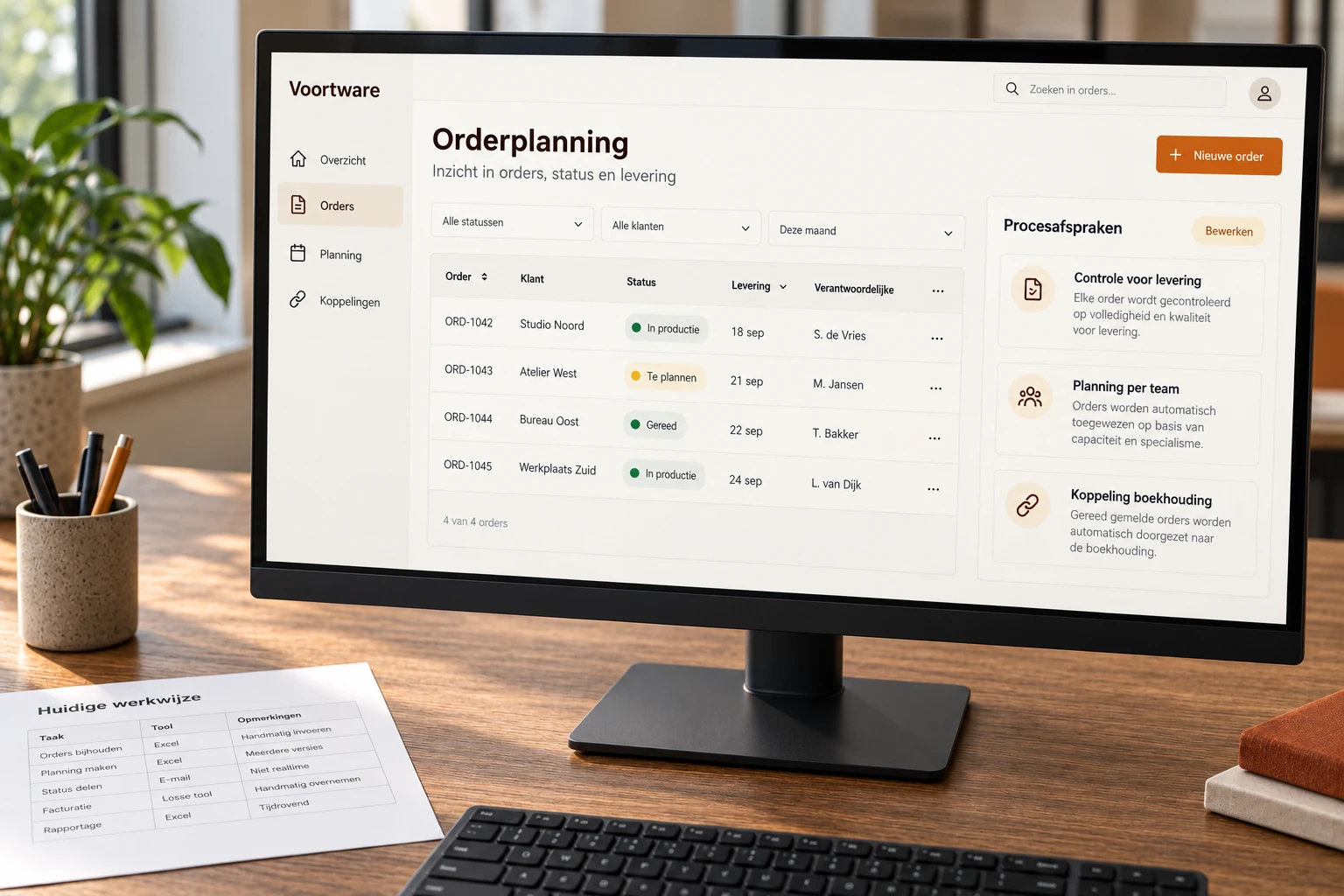
The question 'should we buy a standard package or have custom software built?' is one many business owners ask themselves — and they rarely get an honest answer. Vendors of standard packages say custom is unnecessarily expensive. Custom developers say standard never fits. Both have a vested interest.
We'd rather give you an honest trade-off, because sometimes a standard package is the better choice. And sometimes it clearly isn't. This article helps you draw that line.
When is a standard package sufficient?
A standard package works well when your process resembles that of thousands of other companies. Invoicing, project management, scheduling, email marketing — for these kinds of functions there are excellent packages that run quickly, are well maintained and are affordable per month.
- Your process is generic and doesn't deviate strongly from the market standard
- The number of users is small and grows modestly
- You don't need integrations with other systems, or the integrations are available as standard
- The tool is an aid alongside your work, not the core of your operations
- You want to start quickly and accept that you adapt to the software
In that case: choose the standard package. It saves time and money, and for generic functions custom software is genuinely not needed.
When does custom pay off?
Custom software is worthwhile when your process is unique enough that no standard package supports it well. That sounds vague, so here are three concrete signals:
- Unique processes: your way of working is a competitive advantage. You don't want software dictating how you work, because your approach is what sets you apart from the competition.
- Many users or high transaction volumes: standard packages charge per user or per transaction. At twenty users or a thousand invoices per month, licence costs can quickly exceed the cost of building custom software. This matters most for a client portal, where every client is a user.
- Integration needs with existing systems: if the software needs to connect to your own database, a sector-specific system or a legacy application, a standard package is unlikely to support this, or will do it poorly.
A fourth signal that's less often mentioned: if your team performs work outside the software — in Excel, by email or verbally — because the software can't handle it, that's a clear sign it doesn't fit. That's exactly the gap custom internal tools close.
Comparing the real costs
The purchase price or monthly fee is not the whole story. To make a fair comparison, you need to calculate total cost of ownership over three years.
- Standard package: licence costs × number of users × 36 months, plus implementation costs, plus adjustment costs for every new process or integration
- Custom software: one-off build costs, plus hosting (€ 20–€ 80 per month), plus maintenance costs (optional), plus costs for extensions
In practice we see that standard packages with ten or more users become as expensive as custom, or more so, after two to three years — and you still have software that doesn't fit exactly. Custom has high entry costs but low ongoing costs and scales without extra licence fees.
An honest recommendation
Always start with a standard package if a good option exists for your specific use case. Use it for six to twelve months. Note what doesn't work, where your team works around it and what's hampering your growth. That list is the input for a conversation about custom software.
Custom software isn't a starting point, it's a next step. The companies that get the most out of custom software are those that already know what they need — because they've tried the standard option and hit its limits.
The best custom software is built on real frustrations with a standard package. If you know those frustrations, you know exactly what the custom solution needs to solve.