 Voortware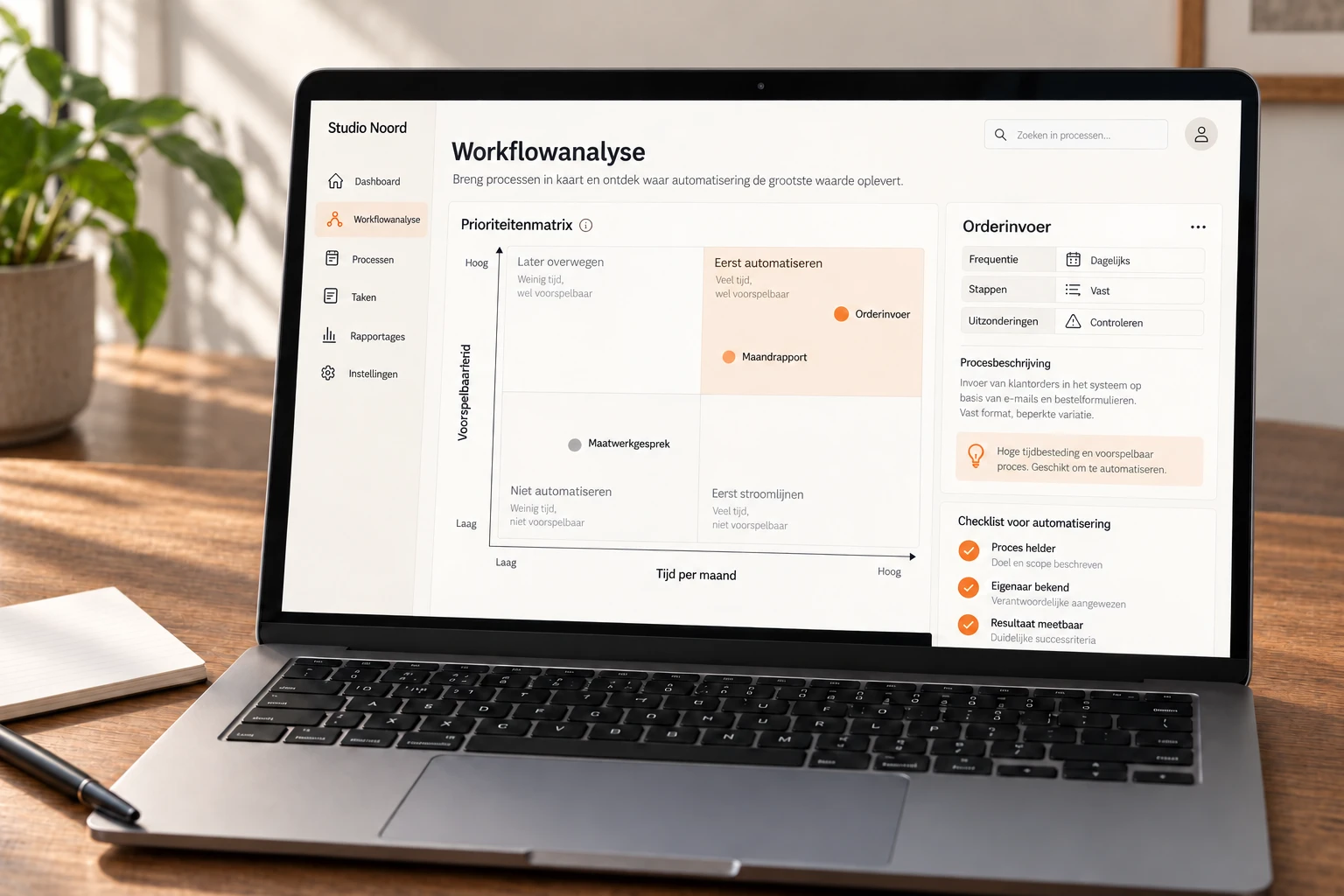
As a business owner you hear it everywhere: automate your processes, save time, increase your margins. And yes, that's true — provided you choose the right processes. In practice we often see companies starting with automation out of enthusiasm, without a clear picture of which tasks are actually suitable.
The result is that tools are built or bought that are barely used after three months. Not because the technology doesn't work, but because the problem was insufficiently defined. This article gives you an honest framework to judge for yourself where workflow automation pays off.
Which processes are suitable for automation?
A rule of thumb: a process is suitable for automation if it meets at least three of the following five criteria.
- The process is performed multiple times per week (high frequency)
- The steps are predictable and always follow the same sequence
- Human decisions are minimal or easy to capture in rules
- Errors in the process are costly, visible or time-consuming to correct
- The output of the process is measurable (a document, an email, an update in a system)
Typical examples in SMEs: creating a quote based on an intake, forwarding invoices to the accountant, registering new clients in multiple systems at once through a CRM integration, or sending reminders for outstanding payments.
When is automation a waste of effort?
There are also processes that are better not automated — or only later, when there is more structure in the organisation.
- Processes that are still evolving: if the rules change every month, automation is too early
- Human contact that adds value: a first client conversation is not a task for a bot
- Exception cases that are the rule: if 40% of cases are 'deviations', there is no real workflow yet
- Processes that occur only a few times a year: the build and maintenance costs then can't be recovered
Automation doesn't fix an unclear process. It speeds up what already exists. If the process itself is chaotic, the chaos gets faster.
How do you determine the order?
Start with a simple matrix. On the horizontal axis: how much time does this process cost per month? On the vertical axis: how predictable is the process? Processes that cost a lot of time and are predictable come first.
In the introduction we do at Voortware, we always work through this matrix together. In thirty minutes you'll know which three processes yield the most gain. And sometimes the conclusion is: wait a little longer.
What is a realistic budget?
A build project starts at € 9,500, for example for a simple automation such as a connection between two systems or an automated email sequence. More complex workflows with multiple steps, integrations and roles go up to € 25,000. In both cases we work with a fixed price upfront and delivery in four to eight weeks on average.